UML 2 Package Diagramming Guidelines

Scott W. Ambler
 
   Home  |  AMDD  |  Best Practices  |  Architecture  |  Requirements  |  Analysis  |  Design  |  Documentation  |  Models  |  Modeling Style  |  Contact Us  |  Mailing List  |  FAQ
Elements of UML 2.0 Style

A package diagram is a UML diagram composed only of packages and the dependencies between them.  A package is a UML construct that enables you to organize model elements, such as use cases or classes, into groups.  Packages are depicted as file folders and can be applied on any UML diagram.  Create a package diagram to:


There are guidelines for:

  1. Class Package Diagrams
  2. Use Case Package Diagrams
  3. Packages


1.        Class Package Diagrams

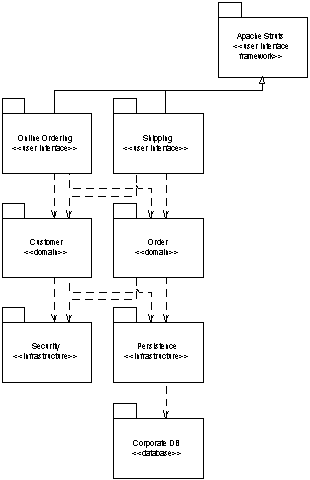
Figure 1. A class package diagram.
 

  1. Create UML Component Diagrams to Physically Organize Your Design.
  2. Place Subpackages Below Parent Packages.
  3. Vertically Layer Class Package Diagrams.
  4. Create Class Package Diagrams to Logically Organize Your Design. Figure 1 depicts a UML Class diagram organized into packages.  In addition to the package guidelines presented below, apply the following heuristics to organize UML Class diagrams into package diagrams:
  • Place the classes of a framework in the same package.
  • Classes in the same inheritance hierarchy typically belong in the same package.
  • Classes related to one another via aggregation or composition often belong in the same package.
  • Classes that collaborate with each other a lot, information that is reflected by your UML Sequence diagrams and UML Collaboration diagrams, often belong in the same package.


2. Use Case Package Diagrams

Use cases are often a primary requirement artifact in object-oriented development methodologies, this is particularly true of instantiations of the Unified Process, and for larger projects package diagrams are often created to organize these usage requirements.  

Figure 2. A UML Use Case diagram comprised mostly of packages.


  1. Create Use Case Package Diagrams to Organize Your Requirements
  2. Include Actors on Use Case Package Diagrams
  3. Horizontally Arrange Use Case Package Diagrams


3.        Packages

The advice presented in this section is applicable to the application of packages on any UML diagram, not just package diagrams.

  1. Give Packages Simple, Descriptive Names
  2.  Apply Packages to Simplify Diagrams
  3. Packages Should be Cohesive
  4. Indicate Architectural Layers With Stereotypes on Packages
  5. Avoid Cyclic Dependencies Between Packages
  6. Package Dependencies Should Reflect Internal Relationships


4. Recommended Resources

Elements of UML 2.0 Style   The Elements of UML 2.0 Style describes a collection of standards, conventions, and guidelines for creating effective UML diagrams. They are based on sound, proven software engineering principles that lead to diagrams that are easier to understand and work with.  These conventions exist as a collection of simple, concise guidelines that if applied consistently, represent an important first step in increasing your productivity as a modeler.  This book is oriented towards intermediate to advanced UML modelers, although there are numerous examples throughout the book it would not be a good way to learn the UML (instead, consider The Object Primer).  The book is a brief 188 pages long and is conveniently pocket-sized so it's easy to carry around.
The Object Primer 3rd Edition: Agile Model Driven Development (AMDD) with UML 2   The Object Primer 3rd Edition: Agile Model Driven Development with UML 2 is an important reference book for agile modelers, describing how to develop 35 types of agile models including all 13 UML 2 diagrams.  Furthermore, this book describes the techniques of the Full Lifecycle Object Oriented Testing (FLOOT) methodology to give you the fundamental testing skills which you require to succeed at agile software development.  The book also shows how to move from your agile models to source code (Java examples are provided) as well as how to succeed at implementation techniques such as refactoring and test-driven development (TDD).  The Object Primer also includes a chapter overviewing the critical database development techniques (database refactoring, object/relational mapping, legacy analysis, and database access coding) from my award-winning Agile Database Techniques book.
Agile Modeling   Agile Modeling: Effective Practices for Extreme Programming and the Unified Process is the seminal book describing how agile software developers approach modeling and documentation.  It describes principles and practices which you can tailor into your existing software process, such as XP, the Rational Unified Process (RUP), or the Agile Unified Process (AUP), to streamline your modeling and documentation efforts.  Modeling and documentation are important aspects of any software project, including agile projects, and this book describes in detail how to elicit requirements, architect, and then design your system in an agile manner.


5. Let Me Help

I actively work with clients around the world to improve their information technology (IT) practices as both a mentor/coach and trainer.  A full description of what I do, and how to contact me, can be found here


Copyright © 2002-2007 Scott W. Ambler


This site owned by
Ambysoft Inc.

Agile Data (AD)  |  Agile Unified Process (AUP)  |  Enterprise Unified Process (EUP)  |  My Writings