UML 2 Deployment Diagramming Guidelines

Scott W. Ambler + Associates
 
   Home  |  AMDD  |  Best Practices  |  Architecture  |  Requirements  |  Analysis  |  Design  |  Documentation  |  Models  |  Modeling Style  |  Contact Us  |  Announcements  |  FAQ
Elements of UML 2.0 Style

A UML deployment diagram depicts a static view of the run-time configuration of hardware nodes and the software components that run on those nodes.  Deployment diagrams show the hardware for your system, the software that is installed on that hardware, and the middleware used to connect the disparate machines to one another.  You create a deployment model to:

  • Explore the issues involved with installing your system into production.
  • Explore the dependencies that your system has with other systems that are currently in, or planned for, your production environment.
  • Depict a major deployment configuration of a business application.
  • Design the hardware and software configuration of an embedded system. 
  • Depict the hardware/network infrastructure of an organization.


There are guidelines for:

  1. General issues
  2. Nodes and Components
  3. Dependencies and Communication Associations


1.        General

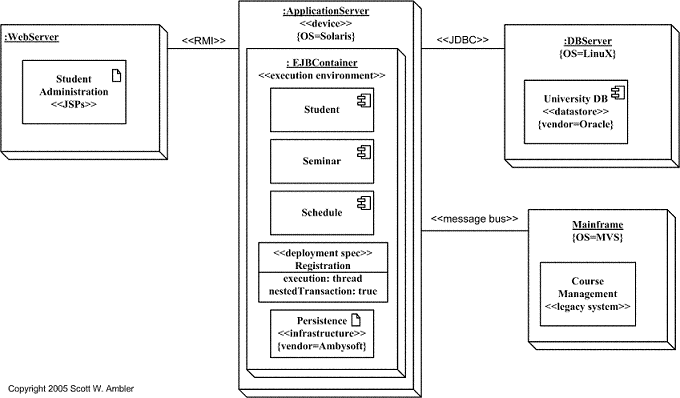
Figure 1. A project-specific UML 2.x Deployment diagram.

Figure 2. A network diagram for an organization.


  1. Indicate Software Components on Project-Specific Diagrams.  Figure 1 depicts a UML Deployment diagram for a university administration system.   
  2. Focus on Nodes and Communication Associations on Enterprise-Level Diagrams.  Figure 2 is an example a style of UML Deployment diagram often referred to as a network diagram or technical architecture diagram, depicting the technical infrastructure of a simple organization.  Note that Figure 2 is a very simple example, many organizations would have tens if not hundreds of nodes on such a diagram.


2.        Nodes and Components

A node, depicted as a three-dimensional box, represents a computational unit, typically a single piece of hardware, such as a computer, network router, mainframe, sensor, or personal digital assistant (PDA).  In UML 2 nodes can also be software.  Components, represent software artifacts such as file, framework, or domain component.

  1. Name Nodes With Descriptive Terms
  2. Model Only Vital Software Components
  3. Apply Consistent Stereotypes to Components
  4. Apply Visual Stereotypes to Nodes


3.        Dependencies and Communication Associations

Communication associations, often called connections, are depicted as lines connecting nodes. Dependencies between components are modeled as dashed arrows, the same notation used on other UML diagrams.

  1. Indicate Communication Protocols Via Stereotypes 
  2. Model Only Critical Dependencies Between Components


4. Recommended Resources

Elements of UML 2.0 Style   The Elements of UML 2.0 Style describes a collection of standards, conventions, and guidelines for creating effective UML diagrams. They are based on sound, proven software engineering principles that lead to diagrams that are easier to understand and work with.  These conventions exist as a collection of simple, concise guidelines that if applied consistently, represent an important first step in increasing your productivity as a modeler.  This book is oriented towards intermediate to advanced UML modelers, although there are numerous examples throughout the book it would not be a good way to learn the UML (instead, consider The Object Primer).  The book is a brief 188 pages long and is conveniently pocket-sized so it's easy to carry around.
The Object Primer 3rd Edition: Agile Model Driven Development (AMDD) with UML 2   The Object Primer 3rd Edition: Agile Model Driven Development with UML 2 is an important reference book for agile modelers, describing how to develop 35 types of agile models including all 13 UML 2 diagrams.  Furthermore, this book describes the techniques of the Full Lifecycle Object Oriented Testing (FLOOT) methodology to give you the fundamental testing skills which you require to succeed at agile software development.  The book also shows how to move from your agile models to source code (Java examples are provided) as well as how to succeed at implementation techniques such as refactoring and test-driven development (TDD).  The Object Primer also includes a chapter overviewing the critical database development techniques (database refactoring, object/relational mapping, legacy analysis, and database access coding) from my award-winning Agile Database Techniques book.
Agile Modeling   Agile Modeling: Effective Practices for Extreme Programming and the Unified Process is the seminal book describing how agile software developers approach modeling and documentation.  It describes principles and practices which you can tailor into your existing software process, such as XP, the Rational Unified Process (RUP), or the Agile Unified Process (AUP), to streamline your modeling and documentation efforts.  Modeling and documentation are important aspects of any software project, including agile projects, and this book describes in detail how to elicit requirements, architect, and then design your system in an agile manner.


Let Us Help

We actively work with clients around the world to improve their information technology (IT) practices, typically in the role of mentor/coach, team lead, or trainer.  A full description of what we do, and how to contact us, can be found at Scott W. Ambler + Associates.

Agile Data (AD)  |  Agile Unified Process (AUP)  |  Enterprise Unified Process (EUP)  |  Disciplined Agile Delivery (DAD)  |  My Writings   |  IT Surveys  

Follow Scott W. Ambler on Twitter

Copyright © 2002-2012 Scott W. Ambler

This site owned by Ambysoft Inc.