
Agile Criteria: Determining Whether a Team is Agile
- Does the team regularly produce value for their stakeholders?
- Does the team validate their work to the best of their ability?
- Are stakeholders actively involved?
- Is the team self-organizing?
- Does the team strive to improve their process?
Value
Is the team producing value to their stakeholders on a regular basis? In the Scrum methodology they talk about delivering “potentially shippable software” every sprint/iteration, and that’s a good start. In the Disciplined Agile (DA) tool kit we have a more robust view in that we believe that a disciplined agile team will produce a consumable solution every iteration, bringing in the idea that the team is producing far more than just working software (they’re also producing supporting documentation, changing the business process, hopefully delivering usable software, …). When I’m assessing a team I expect them to minimally be able to show me the working software that they’ve built to date as well as the source code. The code should be consistent because it will have been written to conform to a common set of guidelines and the team will refactor whenever appropriate to ensure that it remains of high quality. If it is early in the initiative, say the first week or so, then I wouldn’t expect to see much. If they’re at least a few weeks into the effort then I would definitely expect to see some software. If the team is several months into the initiative then I would also expect to see evidence of a track record of producing working software. Figure 1, which summarizes results from the 2013 How Agile Are You? Survey, depicts the adoption rates of various strategies for potentially providing value to stakeholders.
Figure 1. Agile criterion: Value.

Validation
Is the team is doing developer regression testing, or better yet taking a test-driven approach to development? Minimally developers should be testing their code, to the best of their ability, at least daily in a regression manner. With test-driven development (TDD)you write a single test before writing just enough code to fulfill that test. This can be done at the requirements specification level as well at the design level. I will ask a team to show me their test suite. I want to see it run, but anyone on the team, and I want to see the actual source code. I typically look for a roughly 50-50 split between testing code and production code, although 60-40, or 40-60 is also reasonable depending on the situation. If I see an 20-80 split then I know there’s a problem. There are no hard and fast rules, of course. The development team validating their own work is only one part of your overall agile testing strategy. Figure 2 depicts the adoption rate of various validation strategies employed by agile teams.
Figure 2. Agile criterion: Validation.

Stakeholder Involvement
Are stakeholders active participants in development? Your stakeholders can and should be directly involved in the development process (I promote the practice of active stakeholder participation). Minimally stakeholders should be involved on a daily basis, they should provide information in a timely manner and make decisions in a timely manner. When assessing teams, I will ask the team to introduce me to their stakeholder(s) and they should do so right there on the spot, or at least respond with something along the lines of “that would be Beverley, and she’s in a meeting right now and can’t meet with you until 11am.” Figure 3 depicts the adoption rate of common strategies for involving stakeholders.
Figure 3. Agile criterion: Stakeholder involvement.

Self Organization
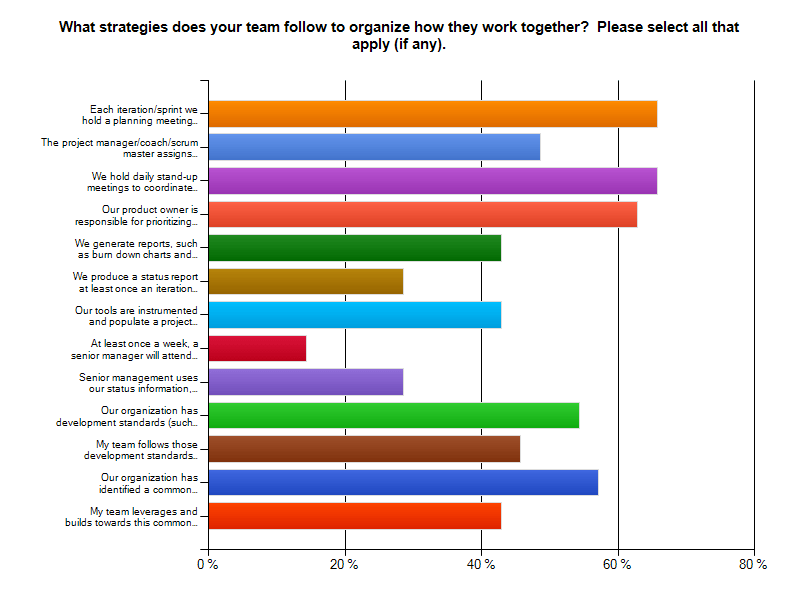
Is the team is working in a highly collaborative, self-organizing manner? More importantly, disciplined agile teams will be doing so within an effective governance framework. Self-organization means that the team members themselves are planning and estimating their own work (granted, perhaps with some facilitation from the team lead/Scrum master). When I’m assessing teams I typically look to see if the team is doing some sort of iteration planning at the start of the iteration, or in the case of lean teams on an as needed basis, as well as daily stand-up meetings (also called Scrum meetings, sigh) to coordinate their efforts. But just because they’re self-organizing doesn’t mean that they’re out of control doing their own thing. Disciplined agile teams will perform their work within the context of an effective governance framework which guides and monitors their efforts, including working towards a common infrastructure (typically driven by your agile enterprise architecture efforts) and common programming guidelines. To determine if agile teams are being governed effectively, which is unfortunately rare in my experience, I look for existence of following common guidelines and working to a common infrastructure, effective metrics reporting (hopefully automated) to management, and better yet evidence that management actually acts on that information to help the team succeed. Sadly,the Agility at Scale survey found that only 11% of respondents indicated that their agile teams found their governance strategies effective Figure 4 summarizes results from the 2013 How Agile Are You? Survey, depicting the adoption rates of various organizational strategies employed by agile teams. Note that having work assigned to you by your team lead or project manager, which appears to be occurring on many “agile teams”, isn’t considered to be self organizing. Figure 4 also covers various governance strategies, sadly indicating that a large percentage of teams are manually reporting metrics and some are producing regular status reports for senior management (regardless of all the rhetoric in the agile community about the evils of doing so).
Figure 4. Agile criterion: Self organization and appropriate governance.
Continual Improvement
Is the team improving their process on a regular basis? A common practice on agile teams is to hold a retrospective at the end of each iteration to identify potential ways to improve their software process. More importantly they act on one or more of their issues the next iteration, improving their approach throughout the initiative. Really disciplined teams make the effort to track their progress over time and share their ideas with other teams. Figure 5 shows adoption rates of relevant improvement strategies employed by agile teams.
Figure 5. Agile criterion: Continuous improvement.

You might find my articles Examining the Agile Manifesto and Agile System Development Lifecycle (SDLC) to be interesting introductions to agile software development. Also, my various agile surveysprovide some insight into the how Agile is being adopted within organizations.